


The Spade We Call a Spade

On cultural identity, teacher ego, and why changing how we teach is harder than it looks.

There is a phrase you will hear in virtually every Ukrainian professional development
works Thop. Someone stands up, looks around the room with the expression of a person about to say something transgressive, and announces: "We need to become more student-centred".
And then everyone goes home and teaches the way they always have.
I have nodded in that room. I have taken those notes. So before I say anything else, let me be clear: this is not a critique from the outside. This is a confession from the inside, from
someone who has spent years at the exact intersection of knowing better and doing otherwise.The question I want to sit with today is not whether we need to change; we do, and most of us know it, but why it is so genuinely, stubbornly, almost physiologically difficult to do so.
The answer, I think, starts not with pedagogy. It starts with culture.
We Are Not Indirect. We Are Honest.

For decades, Ukrainian communication style has been filtered through Edward Halls high-
context/low-context framework: a model that, for all its usefulness, has a way of flattening
what it tries to explain. (Hall proposed these categories in his 1976 book Beyond Culture, and
while they remain a useful starting point in intercultural communication research,
contemporary scholars increasingly caution against applying them as fixed national labels,
see, for instance, Meyer, 2014, The Culture Map, or more recent critiques in applied
linguistics that stress within-culture variation.)
Yes, we are a high-context culture in certain respects: we read silences, we notice what is left
unsaid, we understand that a long pause over tea can carry more meaning than a paragraph of explanation. But "high-context" is too easily misread as "indirect" , and that misreading doesus a disservice.
We are not indirect. We are honest.
Ukrainian directness is not bluntness for its own sake. It is a deeply held cultural conviction
that telling the truth, plainly, without cushioning, is a form of respect. Respect for the
listener intelligence. Respect for the relationship. When we call a spade a spade, we are
saying: I trust you enough not to wrap this in velvet.
When a Western colleague delivers a critique in three layers of softening: "This is a really
interesting approach, and I wonder if perhaps we might consider whether in some contexts it
could potentially be worth exploring an alternative " , we do not feel protected. We feel
misled. We find ourselves wondering what they actually think, and whether we will ever be
permitted to find out.
This matters enormously for pedagogy, because the methods we have been asked to adopt:
communicative language teaching, task-based learning, process writing, reflective feedback,
were largely designed within low-context, high-hedge academic and professional cultures.
The language of those methodologies is the language of suggestion, facilitation, gentle
scaffolding. And when we try to transplant that language into our classrooms, something in
us resists it. Not because we lack sophistication. Because it does not feel like us.
The question is not whether to abandon directness. It is how to build a genuinely student-
centred, critically engaged classroom that is also recognisably Ukrainian — honest, warm,
rigorous, and unafraid to say what it means.
The Sage on the Stage Is Not a Villain

Let me say something that rarely gets said plainly in methodology workshops: the teacheras-authority model is not a relic of Soviet oppression. It is a cultural script that runs far deeperthan any political system, and it has produced generations of genuinely excellent,
knowledgeable, dedicated educators.
The sage on the stage is not a villain. She/he is someone who climbed a very specific
mountain, years of research, publications, examinations, defences, titles, and who stands at
the front of the room with hard-won expertise to offer. The transmission model of teaching
assumes that knowledge is real, that experience matters, and that the person who has spent
thirty years studying the history of the English language, or English stylistics, has something
irreplaceable to give. That assumption is not wrong.
The problem is not that it is wrong. The problem is that it is incomplete.
The world our students are entering does not primarily reward the accumulation and
reproduction of knowledge. It rewards the ability to find, evaluate, apply, and create. It
rewards collaboration, adaptability, and critical thinking. It rewards, in short, exactly the
capacities that student-centred approaches are designed to develop. And if we are honest,
really, uncomplicatedly honest, which is supposed to be our strength, we already know this.
The eternal dilemma of tried-and-true versus cutting-edge is a false one, and I think most of
us sense that too. The question is never really "tradition or innovation". It is: which parts of
our tradition are worth keeping, which parts are ready to evolve, and how do we tell the
difference without either clinging to the past out of fear or throwing it overboard out of
fashion?
A teacher who has spent decades mastering English phonology does not become less valuablein a task-based classroom. They become more valuable because they know exactly when and how to intervene, what matters, and what can wait. The expertise does not disappear. It transforms.
The Part Nobody Likes to Talk About

Here is the harder truth, and I will say it directly, because that is what we do.
A significant part of our resistance to student-centred methods is not intellectual. It is
psychological.
When you have built your professional identity around being the expert, the one who knows,
the one the room looks to, the one who has the authority to evaluate and correct, the arrival of a twenty-year-old who can generate a coherent academic essay in forty seconds using AI is
not simply a pedagogical challenge. It is existential. It does not merely ask you to adjust your
lesson plan. It asks you to rethink who you are in the room.
That is an enormous ask. And pretending it isn't does not help anyone.
Reinventing oneself professionally is genuinely difficult. It is difficult for teachers in Finland,
in Canada, in Japan. It is not a Ukrainian weakness. But we carry an additional layer: the
cultural validation of authority is so strong here, so embedded in how we were trained, how
our students were trained to relate to us, how our institutions were built, that stepping off the
stage feels not just uncomfortable but contrary to our professional instincts. Like we are
doing something wrong.
We are not. But the feeling is real, and ignoring it does not make it go away. The only thing
that seems to help, in my experience, is community — finding colleagues who are in the
same uncertain place, who are willing to say "I tried this and it was a disaster" and "I tried
this and something shifted ", and who give each other permission to be imperfect,
experimental, mid-process.
Which is, of course, exactly what we should be modelling for our students.
The System That Forgot to Change
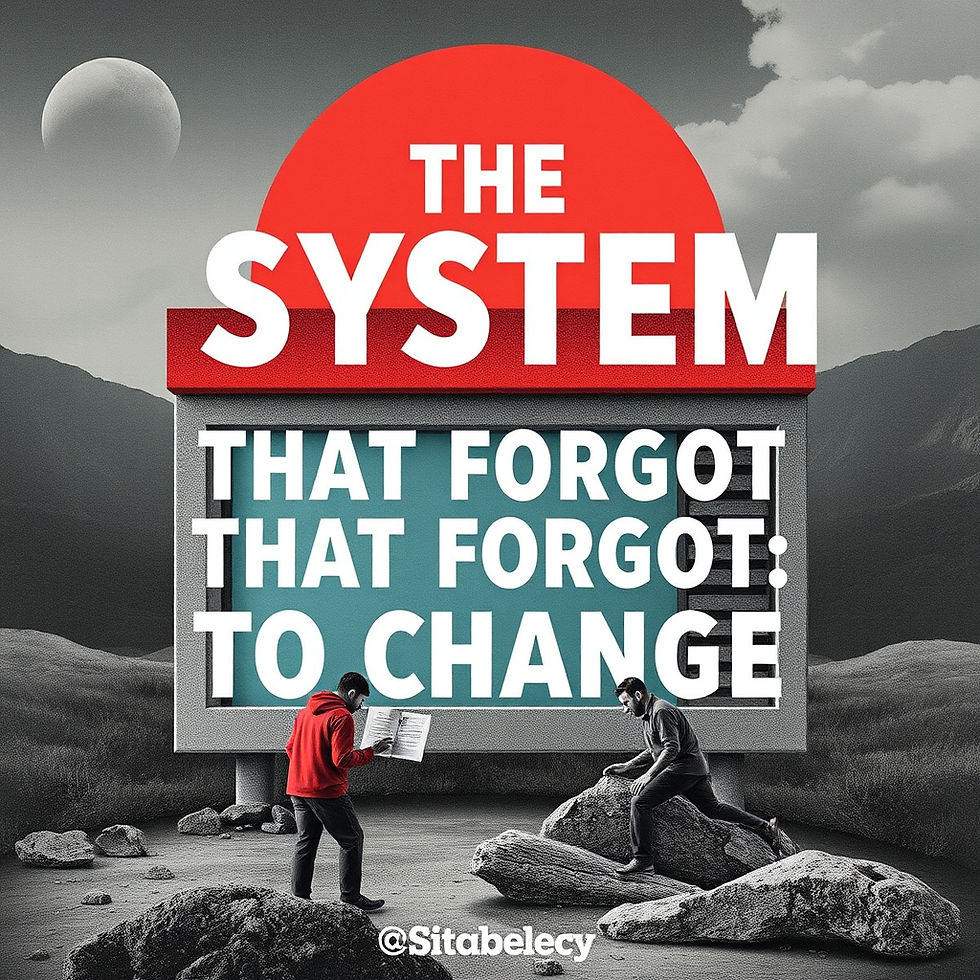
And then there is the third wall. The one that does not move when you push it.
The Ministry of Education and Science has, to its considerable credit, declared student-
centredness, competency-based learning, and European standards as national priorities. These declarations are real, and they matter. But declarations and systems are different things, and our system, architecturally, structurally, was not built for the methodology it now officially endorses.
Teachers at Ukrainian universities carry administrative loads that would stun a logistics
company. If paperwork generated electricity, we could probably solve the country’s energy
problem. Reporting requirements, form-filling, documentation cycles, compliance paperwork — all of this sits on top of actual teaching, which itself sits on top of research expectations, which itself sits on top of the physical and psychological weight of wartime life. The result is a profession running permanently at overcapacity, in which the safest pedagogical choice is always the one that requires the least additional energy.
Rigid state standards compress the space for experimentation. When your syllabus is a legal
document and deviation from it carries professional risk, the cost of trying something new is
asymmetric: the potential gain is a better lesson; the potential cost is a formal complaint. In
that environment, conservatism is not laziness. It is rational self-preservation.
There is also the question of professional development, and here the picture is more
complicated, and more dispiriting, than a simple absence. The opportunities exist. Webinars,
courses, certifications, workshops: there is no shortage of things to attend. What is in short
supply is anything resembling support for attending them. Quality professional development
costs money that teachers pay themselves, and time that teachers carve out of evenings and
weekends, and the reward at the end of it is not better pay, not lighter administrative load, not institutional recognition in any meaningful sense: it is approximately fifty or so points added to a compliance report. A rating. A box, ticked. We are asked to modernise our practice. We are not given the time, the money, or the institutional backing to do it properly.
I want to be careful here, because frustration with the system can become an excuse, and thatis not what I am arguing for. The walls have more give than they appear. There is more room inside any curriculum than its authors intended. And there are colleagues across the country who have found ways to be creative, rigorous, student-centred, and professionally safe all at once. What they nearly all share is a community of some kind — people to think alongside, to borrow ideas from, to debrief with after the lesson that went sideways.
So Where Does That Leave Us?

We are direct people in a profession that has been told its directness is a problem. We are
knowledgeable people in a profession that increasingly insists knowledge is only the starting
point. We are conscientious people working in a system that often rewards compliance more
reliably than creativity. And we are doing all of this in a country that is, at this precise
moment in history, also fighting for its existence.
It would be entirely understandable to look at all of this and conclude that the methodological revolution can wait. There are forms to complete, reports to submit, classes to teach, research to write, students to support, and only so many hours in the day. Most of us are already operating on what feels like the pedagogical equivalent of low battery mode.
But I keep coming back to something I notice in every conversation I have with colleagues —
the real ones, the late-night-coffee ones, the ones where the professional armour comes off.
Underneath the exhaustion, the scepticism, the occasional eye-rolling at the latest educational trend, and the very legitimate frustration with a system that has not caught up with what it officially requires of us, there is something else.
Curiosity. And a quiet, stubborn conviction that what we do matters.
That is not a small thing. That is, in fact, the whole thing.
The cultural script that made us sages was not designed to cage us. It was designed to honour knowledge and responsibility. We can honour those things differently: more dialogically, more collaboratively, more openly, without abandoning what made us good at this in the first place.
The challenge is not to choose between tradition and innovation, authority and collaboration, expertise and student agency. The challenge is learning how to hold them together. A teacher does not become less valuable by stepping away from the centre of the room. Expertise does not disappear when students are given more responsibility. It simply shows up differently.
Perhaps the future is not about replacing the sage on the stage with the guide on the side.
Perhaps it is about knowing when students need one, and when they need the other.
The spade does not have to become a trowel. It just has to learn when to dig, and when to
hand the handle to someone else.
References
Hall, E. T. (1976). Beyond culture. Anchor Books.
Meyer, E. (2014). The culture map: Breaking through the invisible boundaries of global business. PublicAffairs.

Коментарі